


Page 31 - Interface August Issue 2026
P. 31
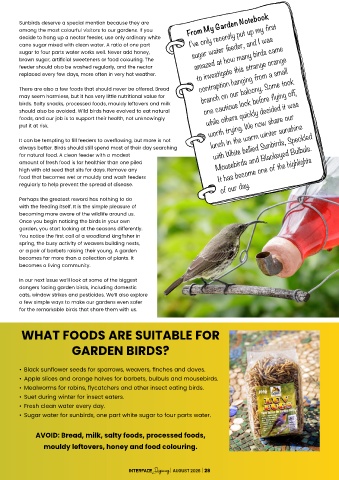
From My Garden Notebook
        Sunbirds deserve a special mention because they are
        among the most colourful visitors to our gardens. If you
        decide to hang up a nectar feeder, use only ordinary white   I’ve only recently put up my first
        cane sugar mixed with clean water. A ratio of one part       sugar water feeder, and I was
        sugar to four parts water works well. Never add honey,
        brown sugar, artificial sweeteners or food colouring. The    amazed at how many birds came
        feeder should also be washed regularly, and the nectar        to investigate this strange orange
        replaced every few days, more often in very hot weather.       contraption hanging from a small

        There are also a few foods that should never be offered. Bread   branch on our balcony. Some took
        may seem harmless, but it has very little nutritional value for
        birds. Salty snacks, processed foods, mouldy leftovers and milk   one cautious look before flying off,
        should also be avoided. Wild birds have evolved to eat natural    while others quickly decided it was
        foods, and our job is to support their health, not unknowingly
        put it at risk.                                                   worth trying. We now share our

        It can be tempting to fill feeders to overflowing, but more is not   lunch in the warm winter sunshine
        always better. Birds should still spend most of their day searching   with White bellied Sunbirds, Speckled
        for natural food. A clean feeder with a modest                       Mousebirds and Blackeyed Bulbuls.
        amount of fresh food is far healthier than one piled
        high with old seed that sits for days. Remove any                     It has become one of the highlights
        food that becomes wet or mouldy and wash feeders
                                                                               of our day.
        regularly to help prevent the spread of disease.
        Perhaps the greatest reward has nothing to do
        with the feeding itself. It is the simple pleasure of
        becoming more aware of the wildlife around us.
        Once you begin noticing the birds in your own
        garden, you start looking at the seasons differently.
        You notice the first call of a woodland kingfisher in
        spring, the busy activity of weavers building nests,
        or a pair of barbets raising their young. A garden
        becomes far more than a collection of plants. It
        becomes a living community.

        In our next issue we’ll look at some of the biggest
        dangers facing garden birds, including domestic
        cats, window strikes and pesticides. We’ll also explore
        a few simple ways to make our gardens even safer
        for the remarkable birds that share them with us.


         WHAT FOODS ARE SUITABLE FOR

                          GARDEN BIRDS?


        • Black sunflower seeds for sparrows, weavers, finches and doves.
        • Apple slices and orange halves for barbets, bulbuls and mousebirds.
        • Mealworms for robins, flycatchers and other insect eating birds.
        • Suet during winter for insect eaters.
        • Fresh clean water every day.
        • Sugar water for sunbirds, one part white sugar to four parts water.


              AVOID: Bread, milk, salty foods, processed foods,

                mouldy leftovers, honey and food colouring.


                                              INTERFACEDigimag | AUGUST 2026 | 29

