


Page 8 - EngineerIT AugustSeptember Issue 2026
P. 8
SCIENCE


        What makes around-the-world


        Pico balloon science so


        remarkable?


        By Hans van de Groenendaal, Science and Technology Writer


                ith a cost-to-science ratio    They float within jet streams. Wind speed and direction are inferred
                of a few hundred rand in       from GPS data transmitted back to Earth via WSPR telemetry, creating a
        Wparts and an amateur radio            continuous global picture of upper-troposphere and lower-stratosphere
        licence, a hobbyist can generate       wind patterns that would be difficult and expensive to gather any other way.
        months of genuine atmospheric data
        from the stratosphere, data that is    WSPR stands for Weak Signal Propagation Reporter and is commonly
        publicly archived and can be used by   pronounced "whisper". Some Pico balloons venture into the polar regions
        researchers.                           and, during the June solstice, can remain in constant sunlight while reaching
                                               extreme Arctic latitudes.
        But I am putting the cart before the
        horse. Let me first explain what a Pico   Balloons orbiting over remote oceans and polar regions are particularly
        balloon is.                            valuable, since weather balloons launched by meteorological services do
                                               not consistently cover these areas. These flights traverse some of the most
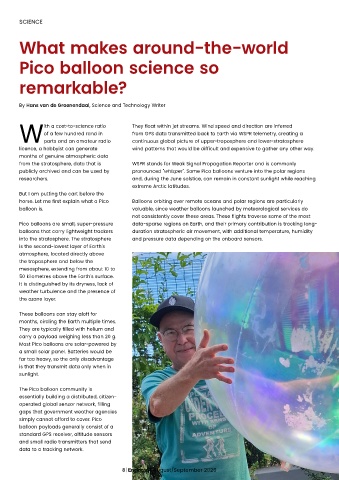
        Pico balloons are small, super-pressure   data-sparse regions on Earth, and their primary contribution is tracking long-
        balloons that carry lightweight trackers   duration stratospheric air movement, with additional temperature, humidity
        into the stratosphere. The stratosphere   and pressure data depending on the onboard sensors.
        is the second-lowest layer of Earth's
        atmosphere, located directly above
        the troposphere and below the
        mesosphere, extending from about 10 to
        50 kilometres above the Earth's surface.
        It is distinguished by its dryness, lack of
        weather turbulence and the presence of
        the ozone layer.

        These balloons can stay aloft for
        months, circling the Earth multiple times.
        They are typically filled with helium and
        carry a payload weighing less than 20 g.
        Most Pico balloons are solar-powered by
        a small solar panel. Batteries would be
        far too heavy, so the only disadvantage
        is that they transmit data only when in
        sunlight.

        The Pico balloon community is
        essentially building a distributed, citizen-
        operated global sensor network, filling
        gaps that government weather agencies
        simply cannot afford to cover. Pico
        balloon payloads generally consist of a
        standard GPS receiver, altitude sensors
        and small radio transmitters that send
        data to a tracking network.


                                            8 | EngineerIT August/September 2026

