


Page 26 - Education Supplement February 2026
P. 26
EDITORIAL


        Where the system struggles
        This is not a failure of individual
        teachers. It is a structural problem.

        Mainstream schools are designed
        around standard pacing, standard
        assessment, and behavioural
        compliance. Teachers are managing
        large classes, fixed curricula,
        and increasing pressure to meet
        measurable outcomes. There is limited
        training in gifted cognition, twice-
        exceptional profiles, or the realities of
        asynchronous development.

        When a child struggles, the system
        tends to look for intervention rather
        than a mismatch. Support is often
        framed as slowing things down,
        simplifying content, or removing     What these children actually need
        challenge altogether. For some       Twice-exceptional learners benefit from environments that recognise the
        learners, this is appropriate. For twice-  whole child. They need deep enrichment rather than surface-level tasks.
        exceptional children, it frequently   Conceptual learning rather than rote repetition. Flexibility in how understanding
        misses the mark.                     is demonstrated. Emotional safety, not constant correction.

        Why are so many 2E children          Most importantly, they need adults who understand that uneven development is
        referred to remedial schools         not a flaw, but a feature of how they learn.
        Remedial schools play a vital and
        necessary role. For learners with    According to Ronél Smit, founder of Nebula College, many of the difficulties
        foundational academic gaps, they     parents encounter are not indicators of low ability, but signals of misalignment.
        provide targeted intervention,
        structure, and support that can be   “We often see children who are deeply capable but completely misunderstood,”
        genuinely life-changing.             she explains. “When the environment changes, their behaviour and confidence
                                             change with it. The issue was never intelligence. It was fit.”
        However, twice-exceptional and
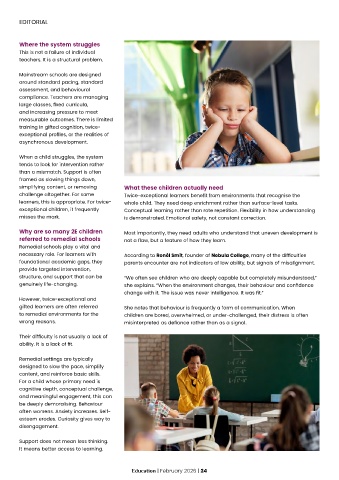
        gifted learners are often referred   She notes that behaviour is frequently a form of communication. When
        to remedial environments for the     children are bored, overwhelmed, or under-challenged, their distress is often
        wrong reasons.                       misinterpreted as defiance rather than as a signal.


        Their difficulty is not usually a lack of
        ability. It is a lack of fit.

        Remedial settings are typically
        designed to slow the pace, simplify
        content, and reinforce basic skills.
        For a child whose primary need is
        cognitive depth, conceptual challenge,
        and meaningful engagement, this can
        be deeply demoralising. Behaviour
        often worsens. Anxiety increases. Self-
        esteem erodes. Curiosity gives way to
        disengagement.

        Support does not mean less thinking.
        It means better access to learning.


                                               Education | February 2026 | 24

