


Page 64 - Education Supplement February 2026
P. 64
EDITORIAL

        Saying stop to bullying


        and meaning it


            ullying rarely looks the way people expect   Giving children tools, not labels
            it to. It is not always loud or physical. More   A central theme of the book is empowerment. Rather than
       Boften, it is quiet, relational and carefully   positioning children as passive recipients of harm, Louise focuses on
        hidden. For many children and teenagers,       restoring agency.
        particularly those who are neurodivergent or
        emotionally vulnerable, its effects can last long   Many children who are bullied carry a sense of shame. They
        after the school years are over.               internalise what is happening and assume there must be something
                                                       wrong with them. This often stops them from asking for help.
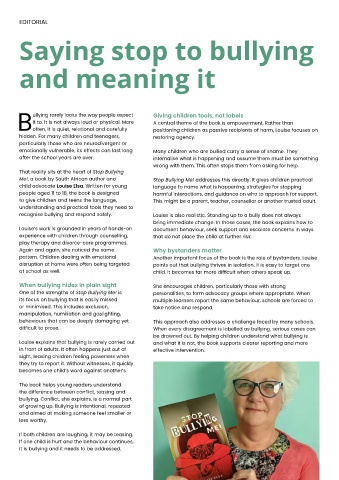
        That reality sits at the heart of Stop Bullying
        Me!, a book by South African author and        Stop Bullying Me! addresses this directly. It gives children practical
        child advocate Louise Elsa. Written for young   language to name what is happening, strategies for stopping
        people aged 11 to 18, the book is designed     harmful interactions, and guidance on who to approach for support.
        to give children and teens the language,       This might be a parent, teacher, counsellor or another trusted adult.
        understanding and practical tools they need to
        recognise bullying and respond safely.         Louise is also realistic. Standing up to a bully does not always
                                                       bring immediate change. In those cases, the book explains how to
        Louise’s work is grounded in years of hands-on   document behaviour, seek support and escalate concerns in ways
        experience with children through counselling,   that do not place the child at further risk.
        play therapy and divorce-care programmes.
        Again and again, she noticed the same          Why bystanders matter
        pattern. Children dealing with emotional       Another important focus of the book is the role of bystanders. Louise
        disruption at home were often being targeted   points out that bullying thrives in isolation. It is easy to target one
        at school as well.                             child. It becomes far more difficult when others speak up.

        When bullying hides in plain sight             She encourages children, particularly those with strong
        One of the strengths of Stop Bullying Me! is   personalities, to form advocacy groups where appropriate. When
        its focus on bullying that is easily missed    multiple learners report the same behaviour, schools are forced to
        or minimised. This includes exclusion,         take notice and respond.
        manipulation, humiliation and gaslighting,
        behaviours that can be deeply damaging yet     This approach also addresses a challenge faced by many schools.
        difficult to prove.                            When every disagreement is labelled as bullying, serious cases can
                                                       be drowned out. By helping children understand what bullying is
        Louise explains that bullying is rarely carried out   and what it is not, the book supports clearer reporting and more
        in front of adults. It often happens just out of   effective intervention.
        sight, leaving children feeling powerless when
        they try to report it. Without witnesses, it quickly
        becomes one child’s word against another’s.

        The book helps young readers understand
        the difference between conflict, teasing and
        bullying. Conflict, she explains, is a normal part
        of growing up. Bullying is intentional, repeated
        and aimed at making someone feel smaller or
        less worthy.

        If both children are laughing, it may be teasing.
        If one child is hurt and the behaviour continues,
        it is bullying and it needs to be addressed.

