


Page 8 - Education Supplement February 2026
P. 8
EDITORIAL

        Teaching children how


        to think is a life skill,


        not an academic extra


               uch of the conversation around education still    As Loryn Dilley explains, “When children are taught
               centres on outcomes. Marks, assessments,          how to think, rather than what to think, they develop
       Mprogression, and curriculum coverage                     skills that support them far beyond the classroom.
        dominate how success is measured. These things           Good thinking underpins learning, relationships, and
        matter, but they are not the point. The skills that shape   wellbeing. It becomes something they carry with them
        a child’s ability to cope with life often sit quietly in the   into everyday life.”
        background, even though they are the ones children
        fall back on when things don’t go to plan.               One of the most persistent misunderstandings is that
                                                                 critical thinking encourages negativity or argument.
        Critical and creative thinking are often positioned as   In practice, well-taught critical thinking is calm and
        enrichment. Useful, but optional. In reality, they sit at   balanced. It teaches children to look at more than one
        the core of meaningful education. These are the skills   side of a situation, to separate facts from opinions,
        children rely on when navigating friendships, managing   and to understand that disagreement does not have
        conflict, making decisions, adapting to change, and      to mean conflict. Just as importantly, it helps children
        solving real problems. Without them, knowledge           learn that changing their minds when new information
        remains fragile and easily overwhelmed by pressure.      emerges is a sign of growth.


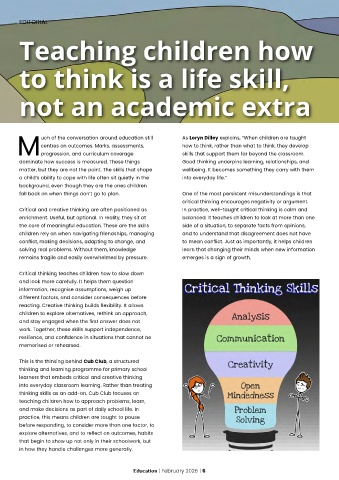
        Critical thinking teaches children how to slow down
        and look more carefully. It helps them question
        information, recognise assumptions, weigh up
        different factors, and consider consequences before
        reacting. Creative thinking builds flexibility. It allows
        children to explore alternatives, rethink an approach,
        and stay engaged when the first answer does not
        work. Together, these skills support independence,
        resilience, and confidence in situations that cannot be
        memorised or rehearsed.


        This is the thinking behind Cub Club, a structured
        thinking and learning programme for primary school
        learners that embeds critical and creative thinking
        into everyday classroom learning. Rather than treating
        thinking skills as an add-on, Cub Club focuses on
        teaching children how to approach problems, learn,
        and make decisions as part of daily school life. In
        practice, this means children are taught to pause
        before responding, to consider more than one factor, to
        explore alternatives, and to reflect on outcomes, habits
        that begin to show up not only in their schoolwork, but
        in how they handle challenges more generally.


                                                Education | February 2026 | 6

