


Page 26 - EngineerIT June July Issue 2026
P. 26
ENGINEERING


        From adopters to originators:


        Why South African engineers


        need to dream bigger


        By Justin Render


              rtificial intelligence, digital twins,   “Transformers have been around for more than 120 years,” he adds. “If you
              automation, smart grids and         look at a substation from 120 years ago and compare it to one today, it
        AIndustry 4.0 have become familiar        looks remarkably similar. The difference is that we can now connect those
        topics in the energy sector. Earlier this   assets, collect data from them and understand what they are telling us.”
        year, at the Africa Energy Indaba, however,
        discussions often came back to how        Local data gives engineers a clearer picture of how equipment is
        companies take these new technologies     performing in the field. Instead of relying solely on inspections or historical
        and apply them in ways that solve real-   records, they can continuously monitor assets, identify recurring issues and
        world problems.                           use operational data to improve future designs.

        For Herman Maré, General Manager          He adds, “Engineering teams are now using technology to analyse data and
        Protection and Control at ACTOM (Pty) Ltd,   streamline workflows. Legal departments can use it to review contracts and
        the conversation begins with localisation.   identify potential risks. Human resources teams can apply it to processes
        As a locally focused manufacturer, the    that involve large volumes of documentation and repetitive administration.”
        company first considers how to adapt
        technology to South African conditions    “Many departments spend significant time on repetitive tasks. The starting
        and incorporate it into local production   point is understanding where people are spending their time and where
        when partnering with international original   technology can help improve efficiency, and the same principle applies to
        equipment manufacturers (OEMs).           infrastructure.”

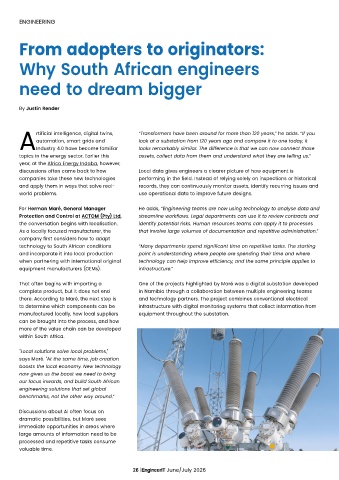
        That often begins with importing a        One of the projects highlighted by Maré was a digital substation developed
        complete product, but it does not end     in Namibia through a collaboration between multiple engineering teams
        there. According to Maré, the next step is   and technology partners. The project combines conventional electrical
        to determine which components can be      infrastructure with digital monitoring systems that collect information from
        manufactured locally, how local suppliers   equipment throughout the substation.
        can be brought into the process, and how
        more of the value chain can be developed
        within South Africa.


        "Local solutions solve local problems,"
        says Maré. "At the same time, job creation
        boosts the local economy. New technology
        now gives us the boost we need to bring
        our focus inwards, and build South African
        engineering solutions that set global
        benchmarks, not the other way around.”

        Discussions about AI often focus on
        dramatic possibilities, but Maré sees
        immediate opportunities in areas where
        large amounts of information need to be
        processed and repetitive tasks consume
        valuable time.


                                                26 | EngineerIT June/July 2026

