


Page 22 - EngineerIT June July Issue 2026
P. 22
ENGINEERING


        Why South Africa needs a National


        Graduate Rotation Programme


        By Hans van de Groenendaal, Science and Technology Writer


             ecently, I had a conversation   Maartens adds, “Today’s plants run   The SAIMC Graduate Rotation for
             with Johan Maartens,         on advanced PLCs, DCS platforms,     Industry Programme (GRIP)
        RExecutive Director of            industrial networks, cybersecurity   The programme proposes giving
        the Society for Automation,       layers, robotics, and data-driven    engineering graduates structured
        Instrumentation, Mechatronics     automation systems. Yet graduates    exposure to:
        and Computer Engineering          entering the workforce often have    •  Vendor Technologies: Graduates
        (SAIMC), about this critically    never touched the equipment that      rotate through leading automation
        important subject: why South      drives South Africa’s mines, factories,   vendors to gain hands-on
        Africa needs a National Graduate   utilities, and processing plants. The   experience with PLCs, DCS, SCADA,
        Rotation Programme.               result is that companies spend 12–24   HMI, instrumentation and process
                                          months retraining graduates before    analytics, robotics and motion
        Are tertiary institutions turning out   they can contribute meaningfully.”  control, industrial networks,
        a market-ready workforce? It is                                         cybersecurity (ISA/IEC 62443),
        a sensitive point of discussion in   Graduates are not ready for        digitalisation, and Industry 4.0
        industry. Johan Maartens believes   modern equipment                    platforms.
        that South Africa’s industrial    At a recent SAIMC Supplier Advisory   •  Industrial Plants: Graduates then
        economy is at a crossroads.       Council meeting, leading automation   rotate through participating industrial
                                          vendors raised a shared concern:      partners to gain real operational
        “Automation, digitalisation,      graduates entering industry have no   experience in commissioning,
        robotics, and AI are accelerating   exposure to the modern equipment    maintenance, troubleshooting, control
        globally, yet our country’s       they will be expected to operate,     system upgrades, instrumentation
        engineering talent pipeline is    maintain, or design around.           calibration, safety systems, and
        struggling to keep pace. The gap                                        production optimisation.
        between what graduates learn at   Maartens states that this is not an   •  Professional Practice: In the final year,
        university and what they encounter   isolated complaint, emphasising, “It is   graduates complete an ECSA-aligned
        in modern industrial plants has   a systemic challenge affecting every   portfolio under mentorship, preparing
        widened to the point where it now   sector - mining, petrochemical, fast-  them for registration as professional
        threatens productivity, safety, and   moving consumer goods (FMCG),     practitioners.
        competitiveness,” he says.        water, energy, and manufacturing.”   •  Maartens believes this is a three-
                                                                                year, ecosystem-wide solution - not
        He adds that this is not a        The meeting discussed ideas for       a short course or a workshop, but a
        criticism of universities, which are   addressing these concerns and    structured national pipeline.
        internationally well-recognised for   came up with a bold proposal: a   •  Strengthening South Africa’s
        their high standards, but rather   national facility, coordinated by the   industrial competitiveness
        a reflection of how fast industrial   SAIMC, where graduates can rotate
        technology has evolved.           through vendor training centres and   Countries that win in automation
                                          industrial plants to gain real, hands-  and digitalisation win in global
                                          on experience.                       competitiveness. South Africa cannot
                                                                               compete with a workforce that is two
                                          “This idea is not only feasible. It is   generations behind the technology
                                          essential,” says Maartens.           curve.


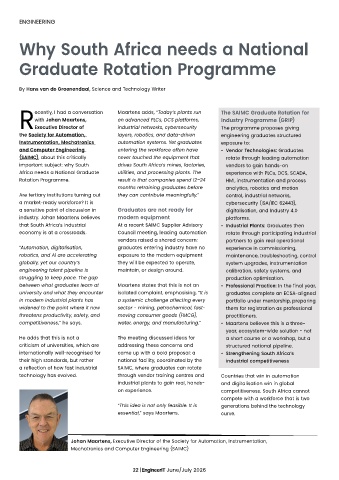
                          Johan Maartens, Executive Director of the Society for Automation, Instrumentation,
                          Mechatronics and Computer Engineering (SAIMC)


                                                22 | EngineerIT June/July 2026

