


Page 17 - EngineerIT June July Issue 2026
P. 17
CYBERSECURITY


         What this means for organisations            Protecting users as a primary entry point
         Ransomware in 2026 is defined by             Many ransomware attacks still begin with user interaction, such
         concentration, not volume. Fewer groups      as phishing emails, malicious links, or compromised credentials.
         now drive the majority of attacks, and       Workspace Security addresses this risk by protecting users across
         these operators are more capable, better     email, browsers, SaaS applications, and endpoints.
         resourced, and harder to disrupt.
                                                      Using AI-driven detection and global threat intelligence, Workspace
          For organisations, this changes the risk    Security blocks delivery vectors, prevents credential abuse, and
          equation:                                   disrupts command-and-control activity, helping organisations contain
           •  Fewer incidents may occur, but each     ransomware before it spreads or encrypts critical systems.
            carries greater potential impact
           •  Attacks are more repeatable and         "For many organisations in Africa, this is a clear sign to review their
            access-driven                             security, especially around exposed systems, cloud access, identity
           •  Prevention and containment matter       protection, user safety, and incident readiness. The real question now
            more than reaction alone                  is not if African organisations will be targeted, but if they are ready to
                                                      handle and recover from more advanced attacks," Hardie concludes.
         In practical terms, defence means:
                                                      Check Point Research will review the key findings from the Q1 2026
         Stopping ransomware at the network and       Ransomware Report at an upcoming webinar, discussing what these
         cloud access layer                           trends mean for organisations and defenders today.
         Ransomware and extortion attacks often
         enter through exposed infrastructure,        Register for the webinar here or download the Q1 report.
         cloud services, or remote access paths.
         This is addressed by applying consistent,
         AI-driven threat prevention across
         networks, clouds, data centres, and
         remote users.

         Capabilities such as network firewalls,
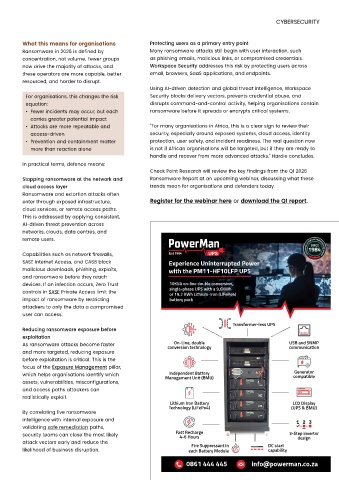
         SASE Internet Access, and CASB block               Experience Uninterrupted Power
                                                            with the PM11-HF10LFP UPS
         malicious downloads, phishing, exploits,
         and ransomware before they reach
                                                             10KVA on-line double conversion,
         devices. If an infection occurs, Zero Trust
                                                             single-phase UPS with a 9,6KWh
         controls in SASE Private Access limit the           or 19,2 KWh Lithium-Iron (LiFePo4)
         impact of ransomware by restricting                 battery pack
         attackers to only the data a compromised
         user can access.
                                                                                   Transformer-less UPS
         Reducing ransomware exposure before
         exploitation
                                                              On-Line, double                          USB and SNMP
         As ransomware attacks become faster
                                                            conversion technology                      communication
         and more targeted, reducing exposure
         before exploitation is critical. This is the
         focus of the Exposure Management pillar,
                                                            Independent Battery                         Generator
         which helps organisations identify which                                                       compatible
                                                           Management Unit (BMU)
         assets, vulnerabilities, misconfigurations,
         and access paths attackers can
         realistically exploit.
                                                             Lithium Iron Battery                       LCD Display
                                                            Technology (LiFePo4)                       (UPS & BMU)
         By correlating live ransomware
         intelligence with internal exposure and
         validating safe remediation paths,
                                                               Fast Recharge                           3-Step invertor
         security teams can close the most likely               4-6 Hours                                 design
         attack vectors early and reduce the
                                                                    Fire Suppressant in        DC start
         likelihood of business disruption.                        each Battery Module         capability
                                                                  0861 444 445            info@powerman.co.za

                                                17 | EngineerIT June/July 2026


                                                   Powerman - engineerIT 105x148_202
                                                                                                                 2024/08/30   05:36
                                                                       4_Aug.indd   1
                                                   Powerman - engineerIT 105x148_2024_Aug.indd   1               2024/08/30   05:36

