


Page 36 - Education Supplement February 2026
P. 36
EDITORIAL

        Inclusion isn’t always


        kind: when support


        isolates children


            or years, inclusion has been
            held up as the gold standard
       Fof modern education. The
        idea is sound: children with
        different learning profiles should
        be supported within mainstream
        environments, rather than
        separated or sidelined. In theory,
        inclusion promotes dignity, access,
        and equality.

        In practice, it can sometimes do the
        opposite.

        This tension sits at the heart of
        a conversation I recently had
        with Barbra Robinson, executive
        principal of Orion College. Robinson
        brings decades of experience
        to the table, including senior
        leadership roles in the UK and
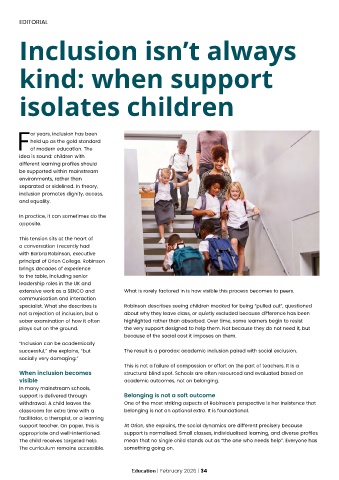
        extensive work as a SENCO and        What is rarely factored in is how visible this process becomes to peers.
        communication and interaction
        specialist. What she describes is    Robinson describes seeing children mocked for being “pulled out”, questioned
        not a rejection of inclusion, but a   about why they leave class, or quietly excluded because difference has been
        sober examination of how it often    highlighted rather than absorbed. Over time, some learners begin to resist
        plays out on the ground.             the very support designed to help them. Not because they do not need it, but
                                             because of the social cost it imposes on them.
        “Inclusion can be academically
        successful,” she explains, “but      The result is a paradox: academic inclusion paired with social exclusion.
        socially very damaging.”
                                             This is not a failure of compassion or effort on the part of teachers. It is a
        When inclusion becomes               structural blind spot. Schools are often resourced and evaluated based on
        visible                              academic outcomes, not on belonging.
        In many mainstream schools,
        support is delivered through         Belonging is not a soft outcome
        withdrawal. A child leaves the       One of the most striking aspects of Robinson’s perspective is her insistence that
        classroom for extra time with a      belonging is not an optional extra. It is foundational.
        facilitator, a therapist, or a learning
        support teacher. On paper, this is   At Orion, she explains, the social dynamics are different precisely because
        appropriate and well-intentioned.    support is normalised. Small classes, individualised learning, and diverse profiles
        The child receives targeted help.    mean that no single child stands out as “the one who needs help”. Everyone has
        The curriculum remains accessible.   something going on.


                                               Education | February 2026 | 34

