


Page 30 - FWG December Issue 2025
P. 30
Estate News


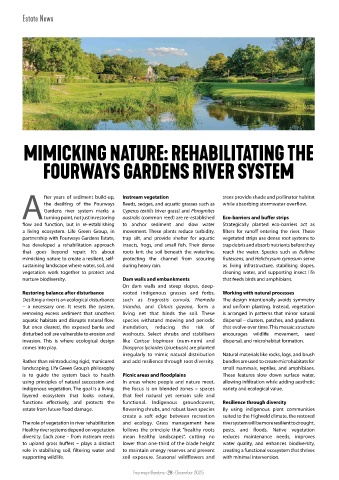
         MIMICKING NATURE: REHABILITATING THE


                FOURWAYS GARDENS RIVER SYSTEM


                 fter years of sediment build-up,   Instream vegetation        trees provide shade and pollinator habitat
                 the desilting of the Fourways   Reeds, sedges, and aquatic grasses such as   while absorbing stormwater overflow.
                 Gardens river system marks a   Cyperus textilis (river grass) and Phragmites
         Aturning point, not just in restoring   australis (common reed) are re-established   Eco-barriers and buffer strips
         flow and function, but in re-establishing   to anchor sediment and slow water   Strategically planted eco-barriers act as
         a living ecosystem. Life Green Group, in   movement. These plants reduce turbidity,   filters for runoff entering the river.  These
         partnership with Fourways Gardens Estate,   trap silt, and provide shelter for aquatic   vegetated strips use dense root systems to
         has developed a rehabilitation approach   insects, frogs, and small fish.  Their dense   trap debris and absorb nutrients before they
         that goes beyond repair. It’s about   roots knit the soil beneath the waterline,   reach the water. Species such as  Bulbine
         mimicking nature to create a resilient, self-  protecting the channel from scouring   frutescens, and Helichrysum cymosum serve
         sustaining landscape where water, soil, and   during heavy rain.      as living infrastructure, stabilising slopes,
         vegetation work together to protect and                               cleaning water, and supporting  insect life
         nurture biodiversity.              Dam walls and embankments          that feeds birds and amphibians.
                                            On dam walls and steep slopes, deep-
         Restoring balance after disturbance   rooted indigenous grasses and forbs,   Working with natural processes
         Desilting a river is an ecological disturbance   such as  Eragrostis curvula, Themeda   The  design  intentionally  avoids  symmetry
         – a necessary one. It resets the system,   triandra,  and  Chloris gayana,  form  a   and uniform planting. Instead, vegetation
         removing excess sediment that smothers   living net that binds the soil.  These   is arranged in patterns that mirror natural
         aquatic habitats and disrupts natural flow.   species withstand mowing and periodic   dispersal – clusters, patches, and gradients
         But once cleared, the exposed banks and   inundation,  reducing  the  risk  of  that evolve over time. This mosaic structure
         disturbed soil are vulnerable to erosion and   washouts. Select shrubs and stabilisers   encourages wildlife movement, seed
         invasion.  This is where ecological design   like  Carissa bispinosa (num-num) and   dispersal, and microhabitat formation.
         comes into play.                   Diospyros lycioides (bluebush) are planted
                                            irregularly to mimic natural distribution   Natural materials like rocks, logs, and brush
         Rather than reintroducing rigid, manicured   and add resilience through root diversity.   bundles are used to create microhabitats for
         landscaping, Life Green Group’s philosophy                            small mammals, reptiles, and amphibians.
         is to guide the system back to health   Picnic areas and floodplains   These features slow down surface water,
         using principles of natural succession and   In areas where people and nature meet,   allowing infiltration while adding aesthetic
         indigenous vegetation. The goal is a living,   the  focus  is on  blended zones  – spaces   variety and ecological value.
         layered ecosystem that looks natural,   that  feel  natural  yet  remain  safe  and
         functions effectively, and protects the   functional.  Indigenous  groundcovers,   Resilience through diversity
         estate from future flood damage.   flowering shrubs, and robust lawn species   By using indigenous plant communities
                                            create a soft edge between recreation   suited to the Highveld climate, the restored
         The role of vegetation in river rehabilitation   and ecology. Grass management here   river system will be more resilient to drought,
         Healthy river systems depend on vegetation   follows the principle that “healthy roots   pests, and floods. Native vegetation
         diversity. Each zone – from instream reeds   mean healthy landscapes”, cutting no   reduces maintenance needs, improves
         to upland grass buffers – plays a distinct   lower than one-third of the blade height   water quality, and enhances biodiversity,
         role in stabilising soil, filtering water and   to maintain energy reserves and prevent   creating a functional ecosystem that thrives
         supporting wildlife.               soil exposure. Seasonal wildflowers and   with minimal intervention.

                                                Fourways Gardens • 28 • December 2025

