


Page 32 - FWG December Issue 2025
P. 32
Gardening


                  PARROT’S FEATHER WEED CONTROL


                    WITH NATURAL BEETLE SOLUTION


               arrot’s Feather  Weed Control is
               an important topic for anyone
               concerned about  the health  of
        Pwetlands and waterways.  This
         invasive aquatic plant, originally from
         South America, has spread across many
         South African water bodies, forming thick
         mats that disrupt native ecosystems.
         Understanding how to manage it naturally
         helps protect biodiversity and maintain
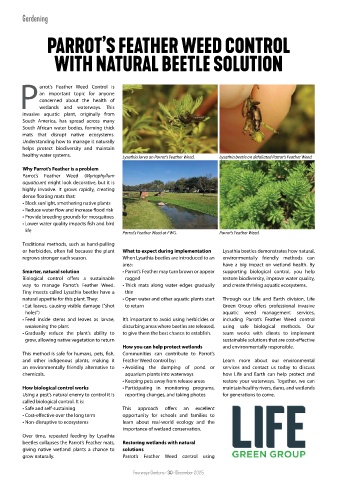
         healthy water systems.             Lysathia larva on Parrot’s Feather Weed.  Lysathia beetle on defoliated Parrot’s Feather Weed.

         Why Parrot’s Feather is a problem
         Parrot’s Feather  Weed (Myriophyllum
         aquaticum) might look decorative, but it is
         highly invasive. It grows rapidly, creating
         dense floating mats that:
         •  Block sunlight, smothering native plants
         •  Reduce water flow and increase flood risk
         •  Provide breeding grounds for mosquitoes
         •  Lower water quality impacts fish and bird
          life                              Parrot’s Feather Weed at FWG.     Parrot’s Feather Weed.

         Traditional methods, such as hand-pulling
         or herbicides, often fail because the plant   What to expect during implementation  Lysathia beetles demonstrates how natural,
         regrows stronger each season.      When Lysathia beetles are introduced to an   environmentally friendly methods can
                                            area:                              have a big impact on wetland health. By
         Smarter, natural solution          •  Parrot’s Feather may turn brown or appear   supporting biological control, you help
         Biological control offers a sustainable   ragged                      restore biodiversity, improve water quality,
         way to manage Parrot’s Feather  Weed.   •  Thick mats  along water edges  gradually   and create thriving aquatic ecosystems.
         Tiny insects called Lysathia beetles have a   thin
         natural appetite for this plant. They:  •  Open water and other aquatic plants start   Through our Life and Earth division, Life
         •  Eat leaves, causing visible damage (“shot   to return              Green  Group  offers  professional  invasive
          holes”)                                                              aquatic weed management services,
         •  Feed inside stems and leaves as larvae,   It’s important to avoid using herbicides or   including  Parrot’s  Feather  Weed  control
          weakening the plant               disturbing areas where beetles are released,   using  safe  biological  methods.  Our
         •  Gradually reduce the plant’s ability to   to give them the best chance to establish.  team works with clients to implement
          grow, allowing native vegetation to return                           sustainable solutions that are cost-effective
                                            How you can help protect wetlands  and environmentally responsible.
         This method is safe for humans, pets, fish,   Communities  can  contribute  to  Parrot’s
         and other indigenous plants, making it   Feather Weed control by:     Learn  more  about  our  environmental
         an environmentally friendly alternative to   •  Avoiding the dumping of pond or   services and contact us today to discuss
         chemicals.                          aquarium plants into waterways    how Life and Earth can help protect and
                                            •  Keeping pets away from release areas  restore your waterways. Together, we can
         How biological control works       •  Participating in monitoring programs,   maintain healthy rivers, dams, and wetlands
         Using a pest’s natural enemy to control it is   reporting changes, and taking photos  for generations to come.
         called biological control. It is:
         •  Safe and self-sustaining        This  approach  offers  an  excellent
         •  Cost-effective over the long term  opportunity for schools and families to
         •  Non-disruptive to ecosystems    learn about real-world ecology and the
                                            importance of wetland conservation.
         Over time, repeated feeding  by Lysathia
         beetles collapses the Parrot’s Feather mats,   Restoring wetlands with natural
         giving native wetland plants a chance to   solutions
         grow naturally.                    Parrot’s Feather  Weed control using


                                                Fourways Gardens • 30 • December 2025

