


Page 7 - Landscape-Issue159
P. 7
PROJECT


                                                               posing ecological risk. Its use is confined strictly to built elements and
                                                               it does not form part of the naturalised landscape matrix.
                                                               Organic compost solution used
                                                               Loop Solutions is a material circularity business that partners with
                                                               local mushroom producers to repurpose spent mushroom media,
                                                               following its primary use. Once the growing cycle is complete and
                                                               the material has been heat treated, Loop Solutions processes it to
                                                               recover fibrous components for nutritional use in dairy feed.
                                                                 The remaining fraction, comprising residual organic fibres,
                                                               together with peat originally sourced from Ireland, is further refined
                                                               and repurposed for soil improvement applications. This combination
                                                               provides both structural capacity and organic content, supporting
                                                               moisture retention, aeration and overall soil functionality.
                                                                 This approach ensures full utilisation of the material stream,
                                                               where nothing is wasted and all components are re-integrated into
                                                               productive use, aligning with the broader sustainability objectives
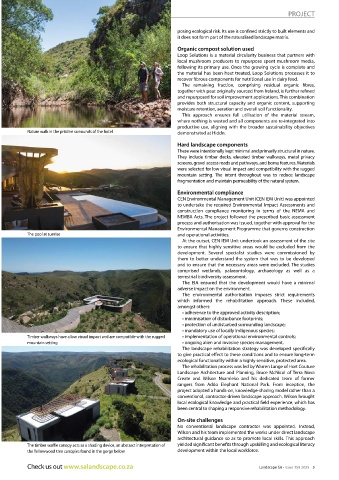
           Nature walk in the pristine surrounds of the hotel  demonstrated at Hiddn.

                                                               Hard landscape components
                                                               These were intentionally kept minimal and primarily structural in nature.
                                                               They include timber decks, elevated timber walkways, metal privacy
                                                               screens, gravel access roads and pathways, and boma features. Materials
                                                               were selected for low visual impact and compatibility with the rugged
                                                               mountain setting.  The intent throughout was to reduce landscape
                                                               fragmentation and maintain permeability of the natural system.

                                                               Environmental compliance
                                                               CEN Environmental Management Unit (CEN IEM Unit) was appointed
                                                               to undertake the required Environmental Impact Assessments and
                                                               construction compliance monitoring in terms of the NEMA and
                                                               NEMBA Acts. The project followed the prescribed basic assessment
                                                               process and authorisation was issued, together with approval for the
                                                               Environmental Management Programme that governs construction
           The pool at sunrise                                 and operational activities.
                                                                 At the outset, CEN IEM Unit undertook an assessment of the site
                                                               to  ensure  that  highly  sensitive  areas  would  be  excluded  from  the
                                                               development. Several specialist studies were commissioned by
                                                               them to better understand the system that was to be developed
                                                               and to ensure that the necessary areas were excluded. The studies
                                                               comprised wetlands, palaeontology, archaeology as well as a
                                                               terrestrial biodiversity assessment.
                                                                 The EIA ensured that the development would have a minimal
                                                               adverse impact on the environment.
                                                                 The environmental authorisation imposes strict requirements
                                                               which informed the rehabilitation approach.  These included,
                                                               amongst others:
                                                                 •  adherence to the approved activity description;
                                                                 •  minimisation of disturbance footprints;
                                                                 •  protection of undisturbed surrounding landscape;
                                                                 •  mandatory use of locally indigenous species;
           Timber walkways have a low visual impact and are compatible with the rugged   •  implementation of operational environmental controls;
           mountain setting                                      •  ongoing alien and invasive species management.
                                                                 The landscape rehabilitation strategy was developed specifically
                                                               to give practical effect to these conditions and to ensure long-term
                                                               ecological functionality within a highly sensitive, protected area.
                                                                 The rehabilitation process was led by Warren Lange of Hort Couture
                                                               Landscape Architecture and Planning, Bruce McNicol of Terra Nova
                                                               Create and  Wilson Nxamleko and his dedicated team of former
                                                               rangers from Addo Elephant National Park. From inception, the
                                                               project adopted a hands-on, knowledge-sharing model rather than a
                                                               conventional, contractor-driven landscape approach. Wilson brought
                                                               local ecological knowledge and practical field experience, which has
                                                               been central to shaping a responsive rehabilitation methodology.
                                                               On-site challenges
                                                               No  conventional  landscape  contractor  was  appointed.  Instead,
                                                               Wilson and his team implemented the works under direct landscape
                                                               architectural guidance so as to promote local skills. This approach
           The timber waffle canopy acts as a shading device, an abstract interpretation of   yielded significant benefits through upskilling and ecological literacy
           the Yellowwood tree canopies found in the gorge below  development within the local workforce.

           Check us out www.salandscape.co.za                                               Landscape SA • Issue 159 2025    5

