


Page 8 - Landscape-Issue159
P. 8
PROJECT


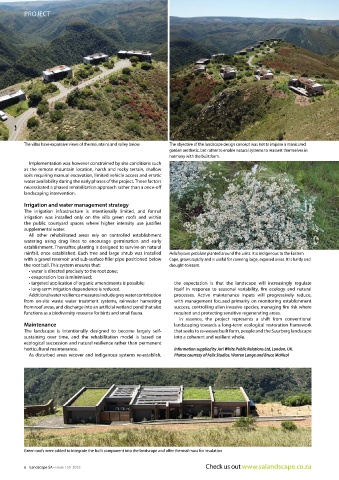
          The villas have expansive views of the mountains and valley below  The objective of the landscape design concept was not to impose a manicured
                                                             garden aesthetic, but rather to enable natural systems to reassert themselves in
                                                             harmony with the built form.
           Implementation was however constrained by site conditions such
          as the remote mountain location, harsh and rocky terrain, shallow
          soils requiring manual excavation, limited vehicle access and erratic
          water availability during the early phases of the project. These factors
          necessitated a phased rehabilitation approach rather than a once-off
          landscaping intervention.
          Irrigation and water management strategy
          The irrigation infrastructure is intentionally limited, and formal
          irrigation was installed only on the villa green roofs and within
          the public courtyard spaces where higher intensity use justifies
          supplemental water.
           All other rehabilitated areas rely on controlled establishment
          watering using drag lines to encourage germination and early
          establishment. Thereafter, planting is designed to survive on natural
          rainfall,  once  established. Each  tree and  large  shrub  was  installed   Helichrysum petiolare planted around the units. It is indigenous to the Eastern
          with a gravel reservoir and sub-surface filler pipe positioned below   Cape, grows rapidly and is useful for covering large, exposed areas. It is hardy and
          the root ball. This system ensures that:           drought-tolerant.
           •  water is directed precisely to the root zone;
           •  evaporation loss is minimised;
           •  targeted application of organic amendments is possible;  the expectation is that the landscape will increasingly regulate
           •  long-term irrigation dependence is reduced.     itself in response to seasonal variability, fire ecology and natural
           Additional water resilience measures include grey water contribution   processes. Active maintenance inputs will progressively reduce,
          from on-site waste water treatment systems, rainwater harvesting   with management focused primarily on monitoring establishment
          from roof areas, and discharge into an artificial wetland pond that also   success, controlling alien invasive species, managing fire risk where
          functions as a biodiversity resource for birds and small fauna.  required and protecting sensitive regenerating areas.
                                                                In essence, the project represents a shift from conventional
          Maintenance                                         landscaping towards a long-term ecological restoration framework
          The landscape is intentionally designed to become largely self-  that seeks to re-weave built form, people and the Suurberg landscape
          sustaining over time, and the rehabilitation model is based on   into a coherent and resilient whole.
          ecological succession and natural resilience rather than permanent
          horticultural maintenance.                          Information supplied by Jori White Public Relations Ltd, London, UK.
           As disturbed areas recover and indigenous systems re-establish,   Photos courtesy of Felix Studios, Warren Lange and Bruce McNicol


          Green roofs were added to integrate the built component into the landscape and offer thermal mass for insulation


          6    Landscape SA • Issue 159  2025                            Check us out www.salandscape.co.za

