


Page 21 - Intra Muros March Issue 2026
P. 21
ESTATE NEWS


                                                                                    Social structure and behaviour
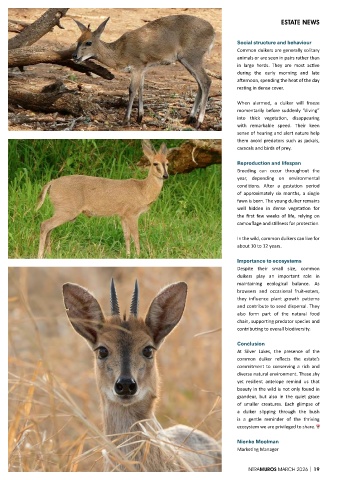
                                                                                    Common duikers are generally solitary
                                                                                    animals or are seen in pairs rather than
                                                                                    in  large  herds.  They  are  most  active
                                                                                    during the early morning and late
                                                                                    afternoon, spending the heat of the day
                                                                                    resting in dense cover.


                                                                                    When  alarmed,  a  duiker  will  freeze
                                                                                    momentarily before suddenly “diving”
                                                                                    into  thick  vegetation,  disappearing
                                                                                    with remarkable speed. Their keen
                                                                                    sense of hearing and alert nature help
                                                                                    them  avoid  predators  such  as  jackals,
                                                                                    caracals and birds of prey.

                                                                                    Reproduction and lifespan
                                                                                    Breeding  can  occur  throughout  the
                                                                                    year,  depending  on  environmental
                                                                                    conditions.  After  a  gestation  period
                                                                                    of  approximately  six  months,  a  single
                                                                                    fawn is born. The young duiker remains
                                                                                    well  hidden  in  dense  vegetation  for
                                                                                    the  first  few  weeks  of  life,  relying  on
                                                                                    camouflage and stillness for protection.


                                                                                    In the wild, common duikers can live for
                                                                                    about 10 to 12 years.

                                                                                    Importance to ecosystems
                                                                                    Despite  their  small  size,  common
                                                                                    duikers play an important role in
                                                                                    maintaining ecological balance. As
                                                                                    browsers  and  occasional  fruit-eaters,
                                                                                    they  influence  plant  growth  patterns
                                                                                    and contribute to seed dispersal. They
                                                                                    also form part of the natural food
                                                                                    chain, supporting predator species and
                                                                                    contributing to overall biodiversity.

                                                                                    Conclusion
                                                                                    At  Silver  Lakes,  the  presence  of  the
                                                                                    common  duiker  reflects  the  estate’s
                                                                                    commitment  to conserving a  rich and
                                                                                    diverse natural environment. These shy
                                                                                    yet resilient antelope remind us that
                                                                                    beauty in the wild is not only found in
                                                                                    grandeur,  but  also  in  the  quiet  grace
                                                                                    of  smaller  creatures.  Each  glimpse  of
                                                                                    a duiker slipping through  the bush
                                                                                    is  a gentle reminder of  the thriving
                                                                                    ecosystem we are privileged to share.

                                                                                    Nienke Moolman
                                                                                    Marketing Manager


                                                                                        INTRAMUROS MARCH 2026 | 19

