


Page 25 - Intra Muros April Issue 2026
P. 25
ESTATE NEWS


        Physical characteristics           Social structure and behaviour   Conclusion
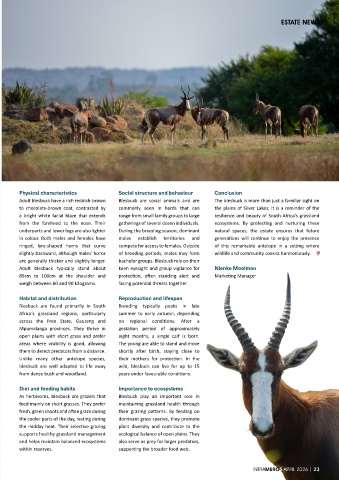
        Adult blesbuck have a rich reddish-brown   Blesbuck  are  social  animals  and  are   The blesbuck is more than just a familiar sight on
        to  chocolate-brown  coat,  contrasted  by   commonly seen in herds that can   the plains of Silver Lakes; it is a reminder of the
        a  bright  white  facial  blaze  that  extends   range from small family groups to large   resilience and beauty of South Africa’s grassland
        from the forehead to the nose. Their   gatherings of several dozen individuals.   ecosystems.  By  protecting  and  nurturing  these
        underparts and lower legs are also lighter   During the breeding season, dominant   natural  spaces,  the  estate  ensures  that  future
        in colour. Both males and females have   males  establish  territories  and  generations  will  continue  to  enjoy  the  presence
        ringed,  lyre-shaped  horns  that  curve   compete for access to females. Outside   of  this  remarkable  antelope  in  a  setting  where
        slightly backward, although males’ horns   of breeding periods, males may form   wildlife and community coexist harmoniously.
        are generally thicker and slightly longer.   bachelor groups. Blesbuck rely on their
        Adult blesbuck typically stand about   keen eyesight and group vigilance for   Nienke Moolman
        85cm to 100cm at the shoulder and   protection,  often  standing  alert  and   Marketing Manager
        weigh between 60 and 90 kilograms.  facing potential threats together.

        Habitat and distribution           Reproduction and lifespan
        Blesbuck  are  found  primarily  in  South   Breeding  typically  peaks  in  late
        Africa’s  grassland  regions,  particularly   summer  to  early  autumn,  depending
        across  the  Free  State,  Gauteng  and   on  regional  conditions.  After  a
        Mpumalanga provinces. They thrive in   gestation  period  of  approximately
        open plains with short grass and prefer   eight  months,  a  single  calf  is  born.
        areas  where  visibility  is  good,  allowing   The young are able to stand and move
        them to detect predators from a distance.   shortly  after  birth,  staying  close  to
        Unlike  many  other  antelope  species,   their  mothers  for  protection.  In  the
        blesbuck are well adapted to life away   wild,  blesbuck  can  live  for  up  to  15
        from dense bush and woodland.      years under favourable conditions.

        Diet and feeding habits            Importance to ecosystems
        As herbivores, blesbuck are grazers that   Blesbuck  play  an  important  role  in
        feed mainly on short grasses. They prefer   maintaining grassland health through
        fresh, green shoots and often graze during   their  grazing  patterns.  By  feeding  on
        the cooler parts of the day, resting during   dominant grass species, they promote
        the midday heat. Their selective grazing   plant diversity and contribute to the
        supports healthy grassland management   ecological balance of open plains. They
        and helps maintain balanced ecosystems   also serve as prey for larger predators,
        within reserves.                   supporting the broader food web.


                                                                                          INTRAMUROS APRIL 2026 | 23

