


Page 38 - EngineerIT AugustSeptember Issue 2026
P. 38
SATELLITE TECHNOLOGY


        Why Africa’s connectivity gap is


        getting bigger, and how we can fix it


        By Justin Render


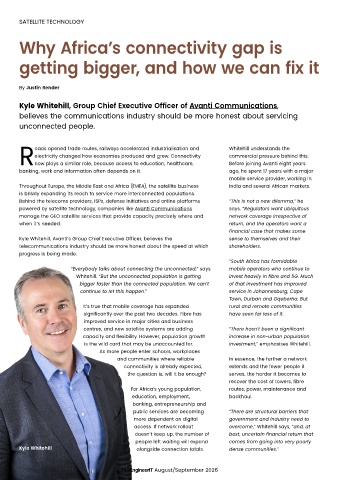
        Kyle Whitehill, Group Chief Executive Officer of Avanti Communications,
        believes the communications industry should be more honest about servicing
        unconnected people.


             oads opened trade routes, railways accelerated industrialisation and   Whitehill understands the
             electricity changed how economies produced and grew. Connectivity    commercial pressure behind this.
        Rnow plays a similar role, because access to education, healthcare,       Before joining Avanti eight years
        banking, work and information often depends on it.                        ago, he spent 17 years with a major
                                                                                  mobile service provider, working in
        Throughout Europe, the Middle East and Africa (EMEA), the satellite business   India and several African markets.
        is briskly expanding its reach to service more interconnected populations.
        Behind the telecoms providers, ISPs, defense initiatives and online platforms   “This is not a new dilemma,” he
        powered by satellite technology, companies like Avanti Communications     says. “Regulators want ubiquitous
        manage the GEO satellite services that provide capacity precisely where and   network coverage irrespective of
        when it’s needed.                                                         return, and the operators want a
                                                                                  financial case that makes some
        Kyle Whitehill, Avanti’s Group Chief Executive Officer, believes the      sense to themselves and their
        telecommunications industry should be more honest about the speed at which   shareholders.
        progress is being made.
                                                                                  “South Africa has formidable
                          “Everybody talks about connecting the unconnected,” says   mobile operators who continue to
                            Whitehill. “But the unconnected population is getting   invest heavily in fibre and 5G. Much
                             bigger faster than the connected population. We can’t   of that investment has improved
                             continue to let this happen.”                        service in Johannesburg, Cape
                                                                                  Town, Durban and Gqeberha. But
                              It’s true that mobile coverage has expanded         rural and remote communities
                              significantly over the past two decades. Fibre has   have seen far less of it.
                              improved service in major cities and business
                              centres, and new satellite systems are adding       “There hasn’t been a significant
                              capacity and flexibility. However, population growth   increase in non-urban population
                               is the wild card that may be unaccounted for.      investment,” emphasises Whitehill.
                                    As more people enter schools, workplaces
                                          and communities where reliable          In essence, the further a network
                                             connectivity is already expected,    extends and the fewer people it
                                              the question is, will it be enough?  serves, the harder it becomes to
                                                                                  recover the cost of towers, fibre
                                               For Africa’s young population,     routes, power, maintenance and
                                               education, employment,             backhaul.
                                                banking, entrepreneurship and
                                                public services are becoming      “There are structural barriers that
                                                more dependent on digital         government and industry need to
                                                access. If network rollout        overcome,” Whitehill says, “and, at
                                                doesn’t keep up, the number of    best, uncertain financial return that
                                                 people left waiting will expand   comes from going into very poorly
        Kyle Whitehill                           alongside connection totals.     dense communities.”


                                            38 | EngineerIT August/September 2026

