


Page 27 - Landscape-Issue 156
P. 27
RECREATION FEATURE


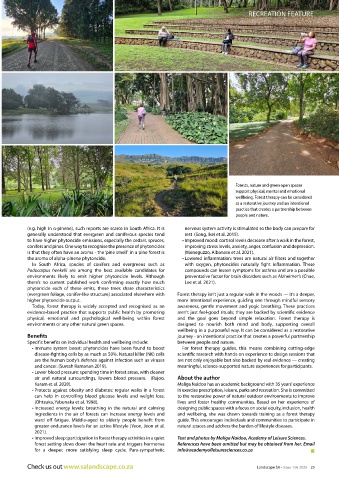
                                                                                    Forests, nature and green open spaces
                                                                                    support physical, mental and emotional
                                                                                    wellbeing. Forest therapy can be considered
                                                                                    as a restorative journey and an intentional
                                                                                    practice that creates a partnership between
                                                                                    people and nature.

           (e.g. high in α-pinene), such reports are scarce in South Africa. It is   nervous system activity is stimulated so the body can prepare for
           generally understood that evergreen and coniferous species tend   rest  (Song, Ikei et al. 2015).
           to have higher phytoncide emissions, especially the cedars, spruces,   •  Improved mood: cortisol levels decrease after a walk in the forest,
           conifers and pines. One way to recognise the presence of phytoncides   improving stress levels, anxiety, anger, confusion and depression.
           is that they often have an aroma - the ‘pine smell’  in a pine forest is   (Meneguzzo, Albanese et al. 2021).
           the aroma of alpha-pinene phytoncide.                 •  Lowered inflammation: trees are natural air filters and together
            In South Africa, species of conifers and evergreens such as   with oxygen, phytoncides naturally fight inflammation.  These
           Podocarpus henkelii are among the best available candidates for   compounds can lessen symptoms for asthma and are a possible
           environments likely to emit higher phytoncide levels. Although   preventative factor for brain disorders such as Alzheimer’s (Chae,
           there’s no current published work confirming exactly how much   Lee et al. 2021).
           phytoncide each of these emits, these trees share characteristics
           (evergreen foliage, conifer-like structure) associated elsewhere with   Forest therapy isn’t just a regular walk in the woods — it’s a deeper,
           higher phytoncide output.                           more intentional experience, guiding one through mindful sensory
            Today, forest therapy is widely accepted and recognised as an   awareness, gentle movement and yogic breathing. These practices
           evidence-based practice that supports public health by promoting   aren’t just feel-good rituals; they are backed by scientific evidence
           physical, emotional and psychological well-being within forest   and  the  goal  goes  beyond  simple  relaxation.  Forest  therapy  is
           environments or any other natural green spaces.     designed to nourish both mind and body, supporting overall
                                                               wellbeing in a purposeful way. It can be considered as a restorative
           Benefits                                            journey - an intentional practice that creates a powerful partnership
           Specific benefits on individual health and wellbeing include:  between people and nature.
            •  Immune system boost: phytoncides have been found to boost   For forest therapy guides, this means combining cutting-edge
             disease-fighting cells by as much as 50%. Natural killer (NK) cells   scientific research with hands-on experience to design sessions that
             are the human body’s defence against infection such as viruses   are not only enjoyable but also backed by real evidence — creating
             and cancer. (Suresh Ramanan 2019).                meaningful, science-supported nature experiences for participants.
            •  Lower blood pressure: spending time in forest areas, with cleaner
             air and natural surroundings, lowers blood pressure.  (Rajoo,   About the author
             Karam et al. 2020).                               Maliga Naidoo has an academic background with 35 years’ experience
            •  Protects against obesity and diabetes: regular walks in a forest   in exercise prescription, leisure, parks and recreation. She is committed
             can help in controlling blood glucose levels and weight loss.   to the restorative power of natural outdoor environments to improve
             (Ohtsuka, Yabunaka et al. 1998).                  lives and foster healthy communities. Based on her experience of
            •  Increased energy levels: breathing in the natural and calming   designing public spaces with a focus on social equity, inclusion, health
             ingredients in the air of forests can increase energy levels and   and wellbeing, she was drawn towards training as a forest therapy
             ward off fatigue. Middle-aged to elderly people benefit from   guide. This encourages individuals and communities to participate in
             greater endurance levels for an active lifestyle (Yeon, Jeon et al.   natural spaces and address the burden of lifestyle diseases.
             2021).
            •  Improved sleep: participation in forest therapy activities in a quiet   Text and photos by Maliga Naidoo, Academy of Leisure Sciences.
             forest setting slows down the heart rate and triggers hormones   References have been omitted but may be obtained from her. Email
             for a deeper, more satisfying sleep cycle. Para-sympathetic   info@academyofleisuresciences.co.za   n

           Check us out www.salandscape.co.za                                              Landscape SA • Issue 156 2025    25

