


Page 14 - Landscape-Issue160
P. 14
PROJECT


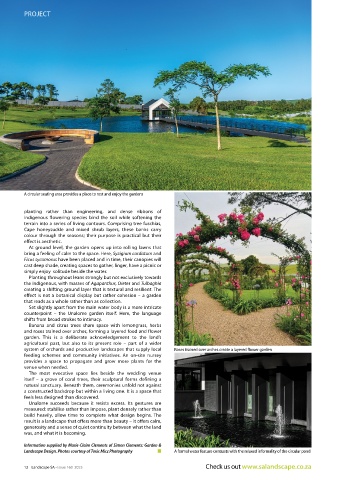
          A circular seating area provides a place to rest and enjoy the gardens


          planting rather than engineering, and dense ribbons of
          indigenous flowering species bind the soil while softening the
          terrain into a series of living contours. Comprising tree fuschias,
          Cape honeysuckle and mixed shrub layers, these banks carry
          colour through the seasons; their purpose is practical but their
          effect is aesthetic.
           At ground level, the garden opens up into rolling lawns that
          bring a feeling of calm to the space. Here, Syzigium cordatum and
          Ficus sycomorus have been placed and in time, their canopies will
          cast deep shade, creating spaces to gather, linger, have a picnic or
          simply enjoy  solitude beside the water.
           Planting throughout leans strongly but not exclusively towards
          the indigenous, with masses of Agapanthus, Dietes and Tulbaghia
          creating a shifting ground layer that is textural and resilient. The
          effect is not a botanical display but rather cohesion – a garden
          that reads as a whole rather than as collection.
           Set slightly apart from the main water body is a more intricate
          counterpoint  –  the  Unalome  garden  itself.  Here,  the  language
          shifts from broad strokes to intimacy.
           Banana and citrus trees share space with lemongrass, herbs
          and roses trained over arches, forming a layered food and flower
          garden.  This is a deliberate acknowledgement to the land’s
          agricultural past, but also to its present role – part of a wider
          system of orchards and productive landscapes that supply local   Roses trained over arches create a layered flower garden
          feeding schemes and community initiatives. An on-site nursey
          provides a space to propagate and grow more plants for the
          venue when needed.
           The most evocative space lies beside the wedding venue
          itself – a  grove  of  coral  trees,  their  sculptural  forms  defining a
          natural sanctuary. Beneath them, ceremonies unfold not against
          a constructed backdrop but within a living one. It is a space that
          feels less designed than discovered.
           Unalome succeeds because it resists excess. Its gestures are
          measured: stabilise rather than impose, plant densely rather than
          build heavily, allow time to complete what design begins.  The
          result is a landscape that offers more than beauty – it offers calm,
          generosity and a sense of quiet continuity between what the land
          was, and what it is becoming.

          Information supplied by Marie-Claire Clements of Simon Clements: Garden &
          Landscape Design. Photos courtesy of Toxic Micz Photography   n  A formal water feature contrasts with the relaxed informality of the circular pond


          12    Landscape SA • Issue 160  2025                           Check us out www.salandscape.co.za

