


Page 21 - IFV Issue 1 January 2026
P. 21
Travel


           late for something, springboks appear and vanish, and the
           whole landscape feels half-dreamed, half-remembered.


           Where Water Cuts Through Stone
           Far south, the Fish River Canyon opens suddenly — a quiet
           thunder in the land. It’s one of the largest canyons in the world,
           but there’s nothing grandiose about it. The silence is steady,
           the scale unshowy. Standing on the rim, you sense how ancient
           this earth is — and how little it asks of you beyond respect.
             The air is dry enough to taste.  The wind has its own
           rhythm. Somewhere below, a single river thread twists
           between shadows. Photographs don’t capture it; they only
           flatten what is, in truth, a living thing.


           Land of Tribes and Memory
           Head north, and Namibia changes tone. The ochre plains give
           way to scrub and smoke, and the light sharpens again. This is
           Kaokoland, home to the proud Himba people, who still live
           much as their ancestors did — herding cattle, tending fires,
           and covering their skin with a deep red mixture of ochre and
           butterfat.
             Visiting a Himba village feels less like looking back in time
           and more like standing still in it. There’s rhythm in their way
           of life, a kind of quiet choreography: women grinding ochre,
           children laughing somewhere unseen, the faint smell of   The Kingdom of Dust and
           woodsmoke and wild herbs curling through the air.  Light
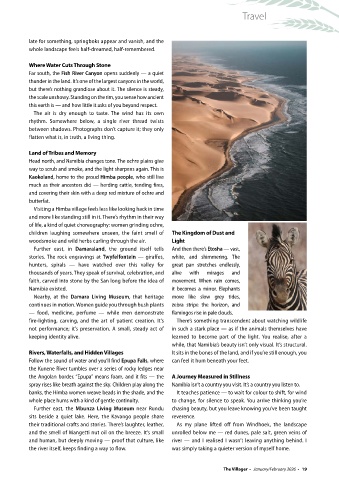
             Further east, in  Damaraland, the ground itself tells   And then there’s Etosha — vast,
           stories. The rock engravings at Twyfelfontein — giraffes,   white, and shimmering.  The
           hunters, spirals — have watched over this valley for   great  pan  stretches  endlessly,
           thousands of years. They speak of survival, celebration, and   alive  with  mirages  and
           faith, carved into stone by the San long before the idea of   movement.  When rain comes,
           Namibia existed.                                  it becomes a mirror. Elephants
             Nearby, at the  Damara Living Museum, that heritage   move like slow grey tides,
           continues in motion. Women guide you through bush plants   zebra stripe the horizon, and
           — food, medicine, perfume — while men demonstrate   flamingos rise in pale clouds.
           fire-lighting, carving, and the art of patient creation. It’s   There’s something transcendent about watching wildlife
           not performance; it’s preservation. A small, steady act of   in such a stark place — as if the animals themselves have
           keeping identity alive.                           learned to become part of the light.  You realise, after a
                                                             while, that Namibia’s beauty isn’t only visual. It’s structural.
           Rivers, Waterfalls, and Hidden Villages           It sits in the bones of the land, and if you’re still enough, you
           Follow the sound of water and you’ll find Epupa Falls, where   can feel it hum beneath your feet.
           the Kunene River tumbles over a series of rocky ledges near
           the Angolan border. “Epupa” means foam, and it fits — the   A Journey Measured in Stillness
           spray rises like breath against the sky. Children play along the   Namibia isn’t a country you visit. It’s a country you listen to.
           banks, the Himba women weave beads in the shade, and the   It teaches patience — to wait for colour to shift, for wind
           whole place hums with a kind of gentle continuity.  to change, for silence to speak. You arrive thinking you’re
             Further east, the  Mbunza Living Museum near Rundu   chasing beauty, but you leave knowing you’ve been taught
           sits beside a quiet lake. Here, the Kavango people share   reverence.
           their traditional crafts and stories. There’s laughter, leather,   As my plane lifted off from  Windhoek, the landscape
           and the smell of Mangetti nut oil on the breeze. It’s small   unrolled below me — red dunes, pale salt, green veins of
           and human, but deeply moving — proof that culture, like   river — and I realised I wasn’t leaving anything behind. I
           the river itself, keeps finding a way to flow.    was simply taking a quieter version of myself home.


                                                                                The Villager  •   January/February 2026  •   19

